
Lin Evans
-
Posts
8,206 -
Joined
-
Last visited
-
Days Won
12
Everything posted by Lin Evans
-
Spellcheck for Text Objects
Lin Evans replied to David Porter's topic in Suggestions for Next Versions
Though we would all love to see spellcheck - keep in mind that PTE is a multi-language software. A totally different reference dictionary then would need to be present for each language by PTE users. Today that is thirteen different languages. It could be extremely difficult and perhaps expensive to implement so that it would make everyone happy. Best regards, Lin -
HI Jeff, It was fun watching PTE evolve and pretty amazing at the capabilities even back nine years ago. You're absolutely right about John Williams - definitely a classic!! Best regards, Lin
-
What can we expect in version 9 ?
Lin Evans replied to thedom's topic in Suggestions for Next Versions
Hi Paul, One can look - but there really are no viable alternatives for PTE IMHO. I have and keep tabs on all the latest software for presentation slideshow creation and there is nothing available which can do what can be already done in PicturesToExe. Unless you are willing to spend a couple thousand dollars for your software, you will not be able to equal the power of PicturesToExe and even with the one extremely expensive German product which has most, but not all of the same capabilities, the ease of use is highly compromised. There is a very good reason why PTE is the overwhelming choice of competitive audio visual creators in the majority of the world. As David points out, there are lots of things going on right now - many of which will be incorporated in the next version of PTE. Best regards, Lin -
Hi Autumn, Keep in mind that PTE slides (a slide is everyting you see on your screen at once) can consist of any number of images (also called objects), but each object exists on a separate "layer." So to see multiple images they must be small enouth that one doesn't overlay the other. If you simply insert two or more images on a single slide, unless you size each of them and position them so that they are each visible, the top layer could hide the image(s) beneath. In order to see two or more images then simply add them as JT has specified, but also move and size them so they are visible. Each object has its own keyframes and you can make any object invisible by either positioning it behind a larger object in a layer above or by adjusting the opacity of the object you wish to hide to zero via keyframing. If you wish to move multiple objects simultaneously, make them a child of a frame (a hidden object) and adjust their positions simultaneously by keframing the parent invisible frame. Best regards, Lin
-
Hi Jim, Indeed, and it's only going to get better with version 9 on the horizon. Amazing what Igor has been able to accomplish with PTE! Best regards, Lin
-
Hey Jim, LOL - close enough! The all look pretty much alike at that age! Best regards, Lin
-
Thanks Robert, It's always fun to go back and see what was going on years ago with PTE. I think I still have a show or two which I made with the first released version of PTE or maybe even before the first release. Best regards, Lin
-
Hi Jim, LOL - they have had their time in the sun! Those little Rocky Mountain Kids were part of a large extended family I found up on Mount Evans in the Rockies at 14,200 feet elevation. They were having the time of their life and kept me and my late wife Sherry amused for about 30 minutes and let us photograph their family fun. The Iguana's name is Rosie and she was a regular at the Westminster, Colorado Butterfly Pavilion many years ago. She was very friendly and the main attraction for many children who came to visit. The paint horse and Indian we captured at a reservation in New Mexico where we were attending one of the Eight Northern Pueblo shows. The dog was Dusty, from one of our eleven pup pit litter born in 1990 which we kept. He was seven years old at the time and passed away the year the show was made. He lived seventeen years and was a great pet. The elk was one from Rocky Mountain National Park Fun memories.... Best regards, Lin
-
Sometimes I visit old sites where I have posted links to shows and correct the URL when I have changed servers or web providers. Today I visited a web site I don't go to very often and corrected some old links which were outdated and no longer functional. In doing this one of the links I corrected was to a little demo I did nine years ago in 2007. It was well received on that website and I thought it would be fun to post it here.... I couldn't find the original PTE file so there is only a link to the Windows zipped exe file but it was fun for me to reflect on what was going on with PTE nine years ago... Maybe some will find it entertaining? http://www.lin-evans.org/pte/3d.zip Zipped Windows Exe (demo of 3D ideas - about 19 meg download) Best regards, Lin
-
Hi Jose, The way I understand it (which may or may not be correct) is that bitrate primarily affects video quality while frame rate affects file size. From this link on the Video Grabber site: Link here: http://www.videograbber.net/reduce-video-size.html You may be correct about bitrate and size but it may be compression differences rather that actual bitrate which is causing the larger file size. If the video size is not small enough, you could also lower frame rate and bit rate. The frame rate has a lot to do with the file size, which displayed images of a video per second. Lowering the frame rate will directly lead to the decrease of video file size. With regard to the bit rate, it mainly describes video or audio quality. If the video file is compressed at higher bitrate, the higher video quality and larger file size will be, and vice versa. In general, we recommend maintaining the lowest acceptable bitrate and frame rate to preserve quality. (emphasis mine) The above quote is a bit confusing because what is really being discussed is compression levels. Lower compression usually increases file size if all other factors remain constant. I've not experimented to confirm the actual effect of only lowering bitrate but the last sentence above in the quote from their site "We recommend...." seems to indicate that having too high a bitrate and frame rate negatively affects quality. Since I usually make executable rather than video for final output, I don't use a great deal of video except for some animations and generally the animated objects are not occupying a major portion of the viewing area. Because of this, I can use less than full HD resolution which preserves file size for the output. I have not been able as yet to make any of my shows with significant amounts of animation look as good in video format as in executable format. Hopefully, with version 9 there will be significant changes but we are not aware yet of just how many changes there will be concerning the new graphical engine. None of us have actually seen that yet and will have to wait until the release of the beta which is expected soon. I don't have any information about 32 versus 64 bit but I know that perhaps having to rewrite all the code to make PTE compatible with both MacIntosh and Windows may probably have much to do with current delays in releasing the first betas. Best regards, Lin
-
Hi Jose, It (the mp4) has a pretty high bitrate which "could" be a problem, but most mp4 files - even the ones PTE creates for HD output are pretty much too compressed for PTE to run smoothly hence the suggestion to convert. It could be that with the new engine for 9.0 and other changes this may be ameliorated in the future. Usually for an MP4 to run smoothly in PTE a full HD (1920x1080) at 30 fps should not be much more than 4,000 kbps to run smoothly. I would think that 17.2 mbps is pretty heavy for a highly compressed MP4 for consumption by PTE. Of course lowering the bitrate and such may make the file much large and one can run into problems in that respect as well. I find that most of my AVI files output by Particle Illusions and BluffTitler run pretty smoothly but I try to keep the size down and never use more than 720p. My wmv files run gine and I've never had problems with Flash FLV but of course the quality is less by nature than MP4 H264. I've not noticed a visible difference in the quality of video files converted by PTE to it's own AVI format but admittedly I don't generally use too many super-high quality video clips in my shows so in that sense perhaps my experience and yours differ. Best regards, Lin
-
"2. However, I am always asking why PTE only accepts the so-called "converted.avi" files, and only avi files made by using PTE converter itself, not an avi file converted using some other converter." I think perhaps you may be creating an AVI with an unavailable CODEC. PTE works fine for me with AVI files from other sources unless they are "uncompressed" AVI's which are not supported by PTE. I use Particle Illusion and Blufftitler both to create AVI files with RGBA (alpha transparency) which work fine with no conversion. In fact, converting them with PTE"s converter would remove the transparent alpha channel. I also create AVI files with other software - all with compression - which work fine with PTE so I think something else is going on with your AVI file which are not compatible. "5. Assuming that PTE only accepts files from its own converter, question is: would it be possible to have some more parameters to choose, in terms of quality, in order that final quality could be the best possible?" Actually, PTE accepts a number of different file formats - certainly not only from its own converter. I use FLV Flash movies, AVI, MP4, MOV and WMV formats. The purpose of the PTE converter is generally to lower the compression which works much better with an executable output file. Many video codec formats are highly compressed and before playing them, the software must first decompress them in real time. Specialized video players are optimized to do this and that is their only task, but PTE is also doing many other things so to get the best performance, a lightly compressed file makes it much easier on the cpu and gpu Best regards, Lin
-
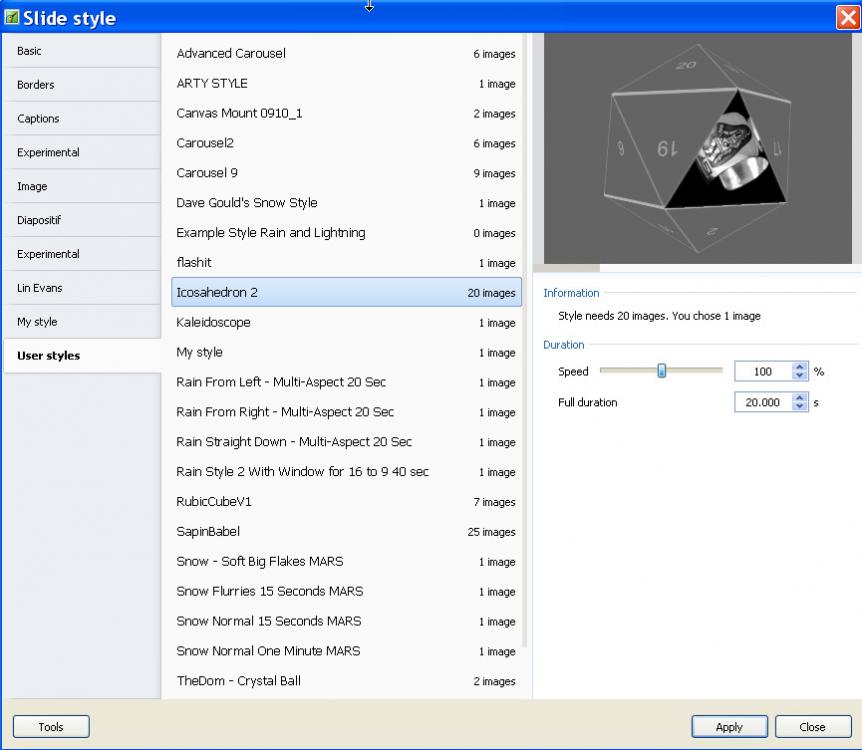
Hi Gogs, Do you mean in addition to the instructions given when a style is selected? Beside the style there is a number representing the number of images needed. Then to the right as seen in the example below, if you have made a mistake in the number of image selected - you will be notified before applying the style???
-
keyframes Multi layered keypoints
Lin Evans replied to Jim Higgins's topic in Suggestions for Next Versions
Hi Jim, There are always situations which might be improved by different views, but having keyframes for all objects on all layers visible simultaneously could very quickly become impractical. Perhaps being able to "select" a few objects and have their keyframes available for view simultaneously could be a usable feature but with PTE sometimes we have literally hundreds of layers in our shows. There isn't a practical limit on the number of objects in separate layers which can be used in a PTE show. There have been shows made with over one thousand layers so to make your suggestion work, it would have to be selective. Best regards, Lin -
Masrawy, As with all previous versions of PicturesToExe, version 9 will be first beta tested by users then debugged thoroughly before the release. The beta testing usually lasts a number of months so no exact release date can be given. Have patience and when the beta is released licensed PTE users can begin using and testing. Best regards, Lin
-
There isn't enough tea in China to persuade me to downgrade to Windows 10.... http://www.networkworld.com/article/2956574/microsoft-subnet/windows-10-privacy-spyware-settings-user-agreement.html Lin
-
It's not a PTE limit, it's a 32 bit limit (PTE is, like many software programs, a 32 bit program). Perhaps in the future when 64 bit code is used, this executable size limit will increase, but many computers and operating systems are still subject to the 32 bit executable file limitations. Even if PTE were presently a 64 bit software, if the 2 gigabyte size limit is exceeded the file would not be compatible with 32 bit systems so a program which ran fine on one system wouldn't necessarily work on another. This would be problematic. In time, all hardware and software will be 64 bit compatible - but not just yet. Lin
-
Using video against multiple background images help
Lin Evans replied to Xenofex2's topic in General Discussion
You don't actually have to set the "link" on the subsequent slides - just copy and paste the video fron the original slide to subsequent slides and move the layers to either place video in background or foreground. The subsequent videos will automatically be set to "link to" the master. Best regards, Lin -
Error 404 means that the HTML page you are trying to access no longer exists on the server.... Erreur 404 signifie que la page HTML que vous tentez d'accéder plus existe sur le serveur ... Lin
-
Of Future Proofing and Picking Nits (by the 1000)
Lin Evans replied to JudyKay's topic in General Discussion
LOL - I wouldn't bother producing any show using images at a resolution higher than about 8 megapixel (3504x2336) unless doing a very deep zoom on an image to 1:1 or greater. As for dynamic range, even though the human eye may be able to detect up to 14 stops or even more, we don't do that all at once but rather in multiple scans and over time. In a single view without the eye changing it's internal brain wired "f/stop" we can only detect about ten stops at max and today's printers can only handle less than that range. Throw in any significant animation and we begin to reach the limits of present day systems to render smoothness when we use ultra high resolution images. Even though displays may produce 8K resolution, it's mostly wasted because unless we are using huge wall sized displays as long as the pixels are smaller than the eye/brain can detect as discrete points of light we have reached the limits of visual resolution. This is why images look so good even at lower resolution on cell phone displays. The same resolution when displayed on say a 60 inch LCD might look pretty jagged. I believe we have long since reached the "practical" resolution limits of conventional photography. Higher resolution cameras are now being used to encompass more real-estate in a single capture than to render greater detail of smaller objects. The new ultra resolution spy cameras take super high resolution video with which the observer can capture a wide geographic area and zoom to a resolution of perhaps a couple inches per pixel rather than see blackheads on the human nose. There is little value in my opinion of rendering greater resolution for practical purposes than the unaided human eye can digest. When we stand face to face and talk with one another, we do not see what we would in a magnifying mirror, so why would we want this level of detail in our slides? If we do, then unless we are photographing moving subjects, we can simply take overlapping telephoto frames and stitch multiple images to allow us the option of zooming into the subject beyond what we could see with the unaided human eye from a distance of a few feet. I think in the future of photography, high resolution sensors will soon be used in holographic projection rather than super resolution 2D frames. Once we perfect sensors which work more like the Foveon rather than the much more common conventional color filter array (CFA) Bayer which interpolates color then we can eliminate the halos and chromatic aberrations which are the bane of present day digital captures and the present sensor resolution will be more than sufficient to produce razor sharp images at reasonable pixel dimensions rather than the megapixel race we have presently dominating marketing. It's exceedingly expensive to produce flawless and very large silicon wafers and because of the costs, cameras such as the 100 megapixel Sony sensor in the new Phase One back are never going to be in common production. The demands on system resources already exceed the value realized by these super high resolution systems IMHO... Best regards, Lin -
Hi John, You might ask Barry - I think he may sometimes use Photoshop for video editing. If you could explain what the issue you're having with exporting "rendered" video for use in PT is, perhaps someone could be more helpful. Personally I use two freeware products (VideoPad Video Editor and AVIdemux 2,5) for my own editing. I understand that the latest versions of Photoshop CC have decent video editing capabilities but I don't use CC so can't help with any useful advice. Best regards, Lin
-
Hi Jeff, That's a great idea. I bought a 30" 2650x1600 resolution display a while back and the difference between it and my old display was absolutely astounding. I would imagine that the difference between my 30" and your 3840x2160 UHD TV would be just as remarkable. The only thing which has held me back from jumping into the UHD arena has been the question of how it would handle animation in terms of ghosting on movement. Hopefully, the new standards have sufficient refresh rates to take care of that. Best regards, Lin
-
If I understand you correctly, you would like to be able to change the layers via keyframes? In other words rather than a layer remaining as it is for the entire duration of the slide, you would like to be able to change the layer position of an object within the slide via a keyframe? Of course presently the layer position is fully adjustable in the Objects and Animations screen, but is fixed for the duration of that slide. To effectively change the layer position the slide would now require duplication. Best regards, Lin
-
Hi Gary, For the same reason we publish Executable files for the PC. A perfectly functioning MP4 file does not equal an Executable file on either a Mac or PC in every case because of the inability for MP4 to animate as smoothly. Executable code generally runs at 60 frames per second and at the present time, mp4 code doesn't have the same capabilities. Yes, it's possible to create 60fps mp4's but in my experience they are not equivalent for animation. The other issue is, of course, that there is no way to manually run an MP4 in executable mode. This means that lots of the things we can do in PTE with executable code (menu's, pop up text, etc.) would not be possible. People using PTE in manual modes would not be able to do so on a Mac (or PC for that matter) without the executable capabilities. Best regards, Lin
-
Merry Christmas to all from Lin & Honey Pup! Lin